Day 7, Thursday, August 2, 2012:
Took bus no 7 and were at
the Dvortsovaya Ploshchad palace square by 8.30. On 1st Thursday of
each month, entry to Hermitage museum is free. We planned to see the
Treasure gallery—the two gold rooms (300 rubles) and the diamond
room (300 rubles) -- which are of course ticketed and there is a
fee for the camera as well (200 rubles).
(If we had not chosen the
free day visit, we would have bought tickets online for 2 days).
The
line started building up and by 9 was stretching till the other end
... we were right at the start ... it was a cold, windy day...13*C as
opposed to the 31*C we had experienced on the day we landed at
Petersburg.
Hermitage Museum, St Petersburg:
As can be seen we were right at the
palace entrance at the beginning of the queue. Sat on the platform
and clicked the pic from that angle. Rested on the platform till the
palace gates opened at 9.30. Can see the long line that had formed behind us...
Alexander Column:
The Alexander Column (Aleksandrovskaya colonna) that towers in the palace square was erected
after the Russian victory in the war with Napoleon's France.
Named
after Emperor Alexander I, who ruled Russia between 1801 and 1825
(during the Napoleonic Wars), this monument — the tallest of its
kind in the world — is 155 ft tall and is topped with a statue of
an angel holding a cross.
The column is a single piece of red
granite, 83 ft tall and 11 ft 5 in diameter. The granite monolith was
obtained from Finland and transported by sea on a barge
specially designed. Without the aid of modern cranes and engineering
machines, the column, weighing 661 tons-- 1,322,760 pounds -- was
erected by 3,000 men in less than 2 hours.
We marveled at the sight
of this tall column which is set so neatly that no attachment to the
base is needed.
At one end of the square
is the bow-shaped Empire-style Building of the General Staff
(1819–29), which centers on a double triumphal arch crowned with a
Roman quadriga (chariot drawn by four horses).
The pedestal of the Alexander Column is
decorated with symbols of military glory.
At the other end is bow-shaped Empire-style Building of the General Staff (1819–29), which centers on a double triumphal arch crowned with a Roman quadriga. (chariot drawn by four horses)
This is the palace facade...
This is the palace square after our day at the
hermitage--costumed Russian model couple available for pics in the
palace background
WINTER PALACE:
The Winter Palace dominates the south
embankment of the Neva River . The first Imperial residence here was
a wooden house in the Dutch style built in 1708 for Peter the Great
and his family. This was replaced in 1711 by a stone building.
Empress Anna Ioannovna created a new, larger palace on the site.
Empress Elizabeth daughter of Peter the Great expanded the building.
The building forms a square with an
interior courtyard . The facades feature two levels of columns, and
the parapets are decorated with statues and vases. The palace is 22m
high, and local planning regulations have prevented any building in
the city centre rising higher than this ever since.
Alexander II was the last of the
Tsars to genuinely use the Winter Palace as his main residence.
After his assassination in 1881, it became clear that the palace was
too large to be properly secured (the first attempt on his life the
year before had been a bomb that damaged several rooms in the palace
and killed 11 guards).
Alexander III and Nicholas II both
set up their family residences at suburban palaces, the former at
Gatchina and the latter at the Alexander Palace in Tsarskoye Selo
(also known as Pushkin which we had visited earlier). The Winter
Palace was only used for official ceremonies and receptions.
In 1905, the Winter Palace witnessed
the Bloody Sunday Massacre on Palace Square, when thousands
of striking workers came to meet the Tsar in peaceful protest and
were fired dead by troops .
Although Nicholas II was not
responsible it marked the beginning of the end for the Imperial
family. In 1914 the Winter Palace was stripped of much of its
wealth and transformed into a temporary hospital for wounded
soldiers.
In 1917, after Nicholas II's abdication
and the February Revolution, the Winter Palace became the seat of the
Provisional Government
The Bolshevik-led revolutionary
forces stormed the palace in October . In the ensuing anarchy, a
portion of the Winter Palace's riches were ransacked, including
the enormous Imperial wine cellars (although the looting did not
extend to the Hermitage).
The Winter Palace was declared part of
the State Hermitage Museum on 17 October 1917
There was further
extensive damage to the building during the Siege of Leningrad by
the Germans in 1941 (WW II)
Restoration returned the Imperial
splendor . The State Rooms of the Winter Palace now form one of the
most popular sections of the Hermitage.
So that’s the great
history behind this three-story palace which is a marvel of Baroque
architecture. It has 1,786 doors, 1,945 windows and 1,057 elegantly
and lavishly decorated halls and rooms.
MUSEUM:
The museum was founded in 1764 when
Catherine the Great purchased a collection of 255 paintings from
the German city of Berlin.
Today, the Hermitage boasts 3 million
exhibits and displays a diverse range of art and artifacts from all
over the world and from throughout history (from Ancient Egypt to the
early 20th century Europe).
The Hermitage’s collections include
works by Leonardo da Vinci, Michelangelo, Raphael and Titian, a
unique collection of Rembrandts and Rubens, many French Impressionist
works by Renoir, Cezanne, Manet, Monet and Pissarro, numerous
canvasses by Van Gogh, Matisse, Gaugin and several sculptures by
Rodin.
If you were to spend a minute
looking at each exhibit on display in the Hermitage, you would need
11 years before you’d seen them all.
The collection contains
2 970 214
items, including: 16 851 paintings, 622 172 graphic art, 12 623
sculptures, 738 389 archeological objects, 301 512 applied art, 1 132
627 numismatics, 146 040 other exhibit items
At 9.30, they opened the
gate and we entered the Great Courtyard – here the queue was split
into 2 – one on each side of the Winter Palace. So smart late
comers rushed to the head of the 2nd line!!
The palace doors opened
at 10 and though it was a free day (first Thursday of the month), we had to go to the ticket
counter—we bought tickets for the two gold rooms (300 rubles) and
the diamond room (300 rubles) and for the camera (200 rubles) —12.45
and 3.30 were the timings for our English tours of the treasure
galleries and we were told where to assemble for the tours.
After
depositing bags in the cloakroom, we ran to our preferred galleries
in the 1st floor per our plan (to beat the crowd).
Jordan Staircase:
The main staircase called
the Jordan Staircase has two broad flights of marble steps leading up
to a landing embellished with grey granite columns. It is adorned
with statues, some of which were brought from Italy in Peter the
Great's reign. The 18th-century ceiling painting in this staircase
depicting Mount Olympus visually enlarges the interior that is
transfused with light, gleaming gold and mirrors.
In the 18th century it was
known as the Ambassadors' Staircase, later the Jordan Staircase,
since the imperial family used it to descend to the Neva at Epiphany
for the ceremony of the Blessing of Waters (in which the river
symbolized the Jordan).
We loved the Pavilion Hall
with its Peacock clock, furniture inlaid with semi precious stones
and ancient Roman mosaic replicated on the floor.
The Raphael Loggia
(copies of Vatican fresco) is awesome. It reproduces the Vatican
gallery in thirteen identical sections, each vault showing 4 scenes
from the Bible. The only changes from the Vatican are replacing the
heraldic spheres of the Medici with a medallion of Raphael and the
coat of arms of Pope Leo X with the Russian eagle and Catherine's
monogram.
Each piece in the Majolica
room is great—such lovely detail.

Silverware was awesome...
Nearby is the room displaying the
huge"Tsarina of Vases", weighing 19.2 tonnes, which took
over eleven years (1831-43) to complete as the jasper stone is hard
but brittle.

Malachite room:
The malachite room (with
pillars, fireplace, table, vase etc all in malachite and a delicate
wall painting with figures representing Day, Night and Poetry) is an awesome sight...
This is the
imperial library (total walnut paneling and shelves),
Peter the Great
(Small Throne) Room...
the stunning armorial hall with huge gold
pillars
The St George (Large Throne) Hall (with its magnificent
parquet floor made from 16 varieties of wood),
the Gold Drawing-room
(again with parquet floor) and solid gold panel walls
the brocade Boudoir, and the study
with mahogany furniture (interior in the apartments of Empress Maria
Alexandrovna, the wife of Alexander) stand out in our memory.
We managed to see lovely
Sèvres porcelain collection, gilded silver craft pieces, ivory
carvings on display along with Michael Angelo’s Crouching Boy and
some paintings of the Italian masters on the 2nd floor, along with several awesome rooms.
Music room here...
Ivory pieces...
There are
seats to rest in some of the galleries and the museum was such a
feast for our aesthetic senses.
Tour
of the treasure rooms:
In between, we ran down to
the ground floor to join the tour of the treasure rooms—we were 5
minutes early for the diamond room tour and our guide came in a few
minutes late with her private group of 6 people. We admired the
Greek/roman statues in the Jupiter hall and the galleries nearby till
our guide turned up.


We got to see all these and much more. These pics are from official site, no private pics allowed (beauty of the gems has hardly come through in these pics):
After the tour we had some
pastries and ice creams at the cafeteria and resumed our journey
through the galleries.
Gold rooms tour:
We could not find our way to the gold rooms by
3.30 and when we requested help, a Russian official in a suit
personally took us to the gold rooms. Very kind of him to go out of
his way to help us!! The elderly lady guide there was the best one
could hope for and showed us the intricate details of the 1500 pieces
displayed there.

We lingered on for a good 10 minutes after our group
had left for both the tours till a guard politely requested us to
exit.
The halls became quite
empty as the afternoon progressed and we almost had the whole place
to ourselves. We scurried from one hall to another consulting our
maps and managed to see all the state apartments. Antiquity section
was mostly uncovered though and we missed the impressionism gallery
as well. It is not a single direction route and is quite difficult to
negotiate without missing some awesome hall just adjacent.
We had been one of the
first to enter and were the very last to leave the beautiful palace
museum. After collecting our bags from the cloakroom, we had our
packed lunch at the palace ground and got out at 6.30 when the guards
started closing the gate.
Church of Savior on
Spilled Blood (Tserkov Spasitelya Na Krovi):
Took a bus and got down
after Kanal Gribedovo and walked to the Church of Savior on Spilled
Blood. As already mentioned, the road Nevsky prospect is cut by 3
rivers, Moskvi, Gribedovo and Fontanki and of course the huge Neva
river runs in front of the winter palace. It is easy to link
landmarks to these rivers,
Petersburg's
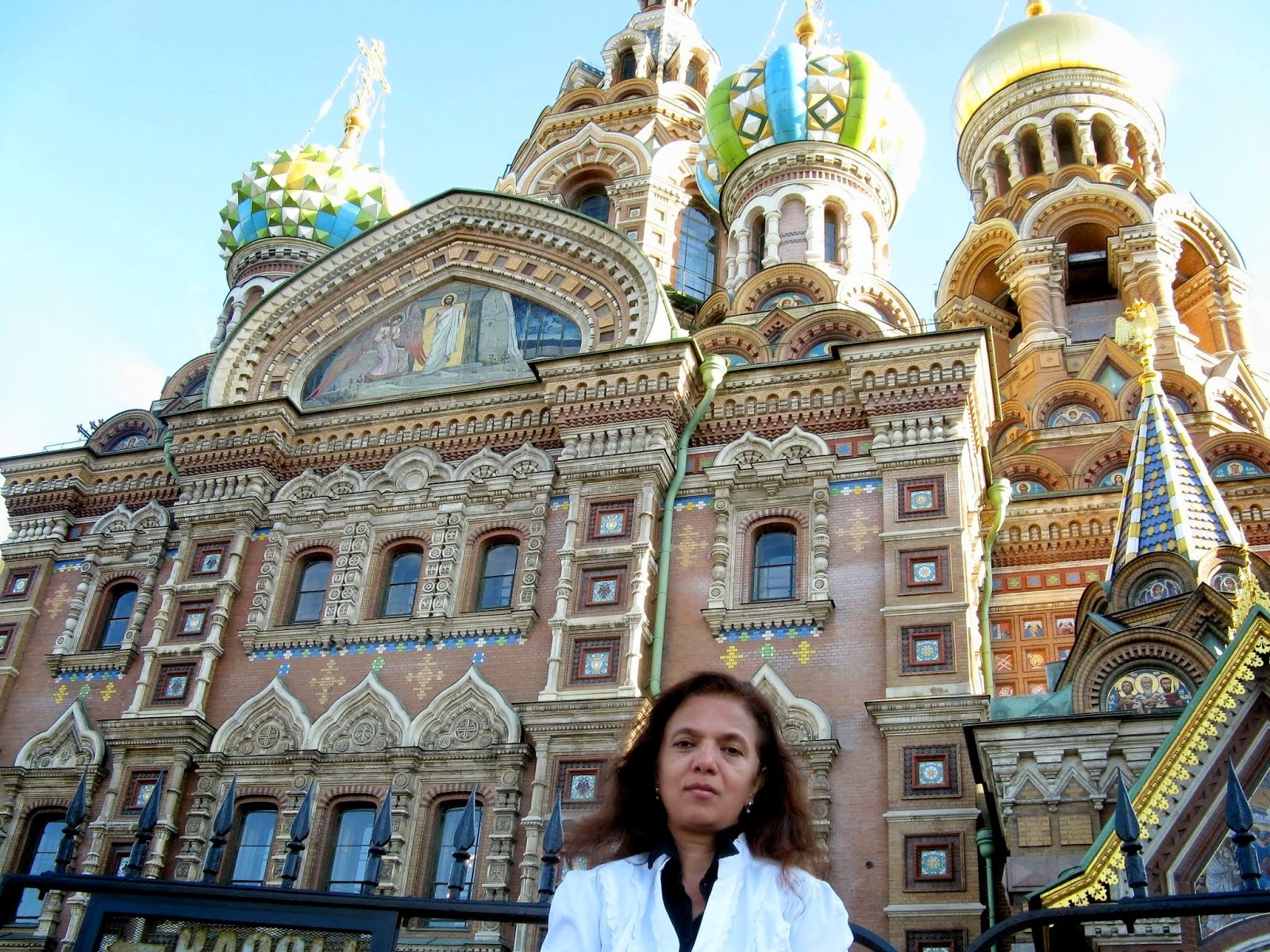
most-photographed church, this cathedral is a mountain of bright,
beveled domes topped by gold crosses. It was built between 1883 and
1907 on the site where Tsar Alexander II was assassinated in 1881,
prompting residents to call it Church of Savior on Spilled Blood
(Tserkov Spasitelya Na Krovi). The official name is Church of the
Resurrection of Christ.


After assuming power in
1855 in the wake of Russia’s disastrous defeat in the Crimean war
against Britain, France and Turkey, Alexander II initiated a number
of reforms. In 1861 he freed the Russian serfs (peasants, who were
enslaved to their owners) and undertook a rigorous program of
military, judicial and urban reforms, never before attempted in
Russia. However, during the second half of his reign Alexander II
became unpopular—there were a series of attempts on his life,
including an explosion in the Winter Palace and the derailment of a
train.
He was finally
assassinated in 1881 by a group of revolutionaries, who threw a bomb
at his royal carriage... his son Alexander III had a church built at
the same spot!! The cobblestone pavement where the king was killed
has been fenced and red roses grow in the very spot facing the altar
in this church.
The church was closed for services in the 1930s, when
the Bolsheviks went on an offensive against religion and destroyed
churches all over the country. It was used as a warehouse for
vegetables and even as a temporary mortuary for a while...It remained
closed and under restoration for over 30 years and was finally
re-opened in 1997 in all its dazzling former glory.
On that day, the cathedral
was open till 8PM, ticket offices were open till 7 and that's how we
were able to visit it after a full day at the hermitage. The church's
interior is elaborately decorated with over 6000 sqm of mosaic and we
plonked ourselves on the floor and gazed in awe at the awesome icons.


We came out after 8.30
 Sat at the canal side for a while and then walked towards Nevsky
prospect. Kazan cathedral is just opposite but my feet were
protesting. So we hopped onto a bus and got down at Ploshchad
Vosstaniya and marched on to our hotel Roses
Sat at the canal side for a while and then walked towards Nevsky
prospect. Kazan cathedral is just opposite but my feet were
protesting. So we hopped onto a bus and got down at Ploshchad
Vosstaniya and marched on to our hotel Roses